 VStack
Algorithm
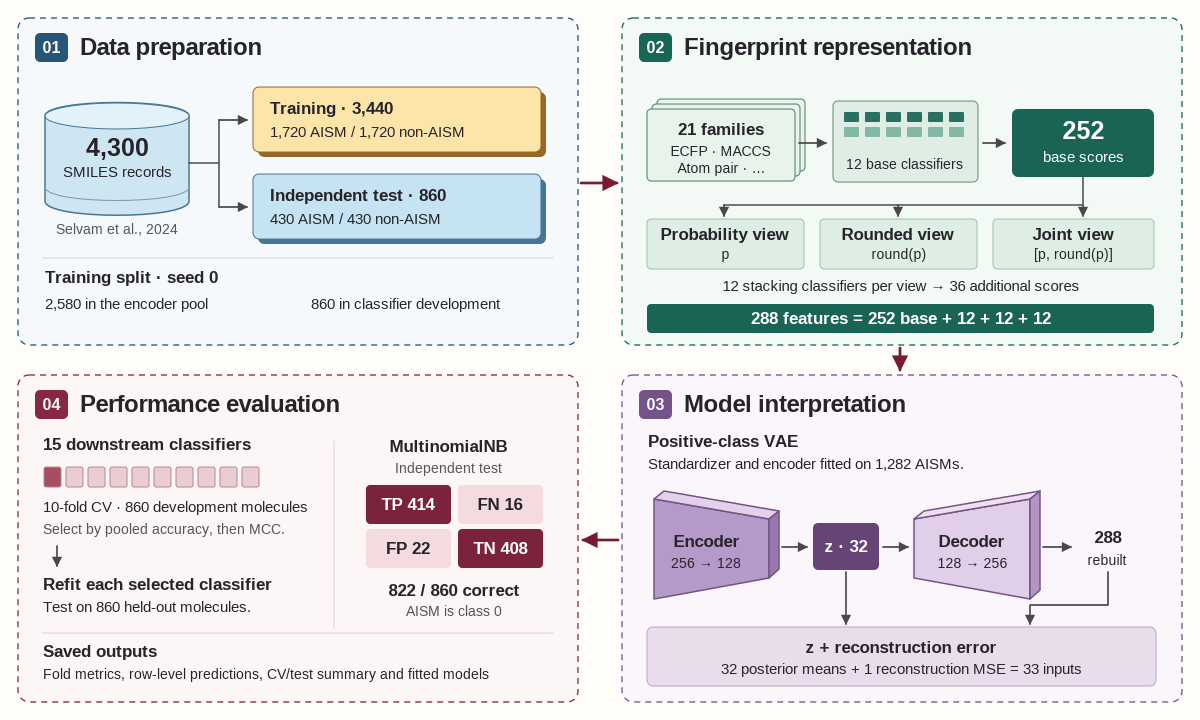
How VStack-AISM builds z + reconstruction error and evaluates 15 classifiers on the same molecular structures.
Classifier comparison
All 15 classifiers used the same 33 inputs and the same 860 independent test molecules.
| Classifier | CV accuracy | Test correct / total | Test accuracy | Test MCC | Test ROC AUC |
|---|---|---|---|---|---|
| MultinomialNB | 0.8837 | 822 / 860 | 0.9558 | 0.9117 | 0.9753 |
| KNN | 0.8837 | 816 / 860 | 0.9488 | 0.8980 | 0.9651 |
| LDA | 0.8895 | 814 / 860 | 0.9465 | 0.8938 | 0.9728 |
| LogisticRegression | 0.8895 | 809 / 860 | 0.9407 | 0.8824 | 0.9726 |
| ExtraTrees | 0.8895 | 802 / 860 | 0.9326 | 0.8682 | 0.9736 |
| GaussianNB | 0.8837 | 802 / 860 | 0.9326 | 0.8689 | 0.9736 |
| RandomForest | 0.8849 | 794 / 860 | 0.9233 | 0.8498 | 0.9733 |
| PLS | 0.8849 | 791 / 860 | 0.9198 | 0.8442 | 0.9715 |
| DecisionTree | 0.8430 | 790 / 860 | 0.9186 | 0.8385 | 0.9335 |
| AdaBoost | 0.8651 | 788 / 860 | 0.9163 | 0.8355 | 0.9704 |
| LightGBM | 0.8814 | 781 / 860 | 0.9081 | 0.8221 | 0.9707 |
| LinearSVC | 0.8849 | 778 / 860 | 0.9047 | 0.8173 | 0.9690 |
| SVC | 0.8860 | 777 / 860 | 0.9035 | 0.8170 | 0.9716 |
| XGBoost | 0.8674 | 775 / 860 | 0.9012 | 0.8085 | 0.9680 |
| MLP | 0.8430 | 763 / 860 | 0.8872 | 0.7799 | 0.9346 |
Read the four-stage protocol
Data preparation
The 3,440 training molecules were split with seed 0 into an encoder pool of 2,580 and a classifier development set of 860. A separate independent test set contained 430 AISMs and 430 non-AISMs. Class 0 denotes AISM throughout. View the two source datasets.
Fingerprint representation
For each SMILES string, 12 base classifiers score each of 21 scaled fingerprint and descriptor families. The resulting 252 class-0 probabilities form three views: the probabilities themselves, their rounded indicators, and both concatenated. A bank of 12 stacking classifiers processes each view. Appending the 36 new scores to the original 252 gives 288 ordered features.
Model interpretation
The standardizer and variational autoencoder were fitted on the 1,282 AISMs in the encoder pool. The encoder maps 288 standardized inputs through hidden layers of 256 and 128 units to 32 posterior means, z. The decoder reconstructs the 288 inputs from those means. Reconstruction error is the average squared difference between the standardized input and its reconstruction for that molecule. Appending this scalar to z gives the same 33 inputs to every candidate classifier.
Performance evaluation
Each classifier was tuned on the 860 development molecules using ten predefined folds inherited from the original row assignments. Each setting produced a held-out score for every development molecule. Settings were ranked by pooled out-of-fold (OOF) accuracy, then MCC, with grid order resolving exact ties. Each classifier used its selected setting and all 860 development molecules for its final fit.
All 15 fitted classifiers scored the same 860 independent test molecules. A class-0 score above 0.5 gives an AISM call. ROC AUC uses the continuous score. The recorded metrics are accuracy, sensitivity, specificity, Matthews correlation coefficient (MCC), ROC AUC, precision, recall and F1. MultinomialNB with α = 10 had the highest independent-test accuracy in this comparison, with 822 correct calls.
The experiment saved the grid search (grid.csv), per-fold metrics (folds.csv), row-level OOF scores and calls (oof.csv), independent-test scores and calls (predictions.csv), and fitted classifiers. The downloadable comparison includes hyperparameters, CV and test metrics, confusion counts and fold-level standard deviations for all 15 classifiers.